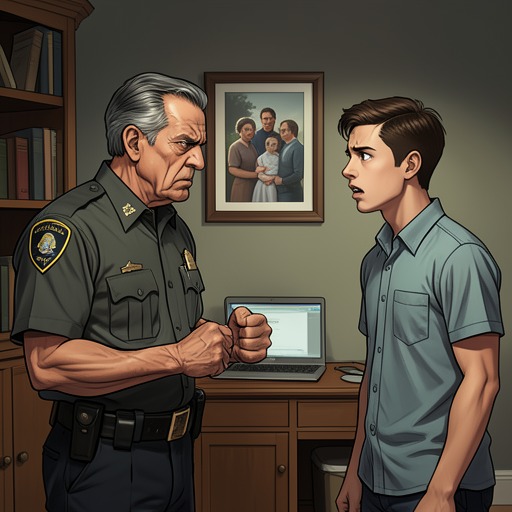
Sheriff Stilinski's suspension
Holding Out for a Hero ▸ Stiles Stilinski (2)Sheriff Stilinski's suspension, formally described as a leave of absence, marks a decisive collapse of institutional protection in Beacon Hills. The action follows the discovery that Stiles Stilinski has stolen a police vehicle and is subject to a restraining order filed by the town's most respected attorney. Rather than treating the crisis as an emergency requiring discretion, county authorities interpret the sheriff's connection to his son's conduct as a public and professional liability.
Causes and Institutional Pressure
The immediate background is the teenagers' attempt to contain Jackson Whittemore after his transformation into the Kanima. Carson Bradley, Stiles Stilinski, and Scott McCall use a stolen police vehicle to keep Jackson from hurting anyone, an act Carson recognizes as illegal even while understanding its protective purpose. The improvised detention places the teenagers outside normal procedure: they are trying to prevent violence, but they do so by appropriating the very machinery of law enforcement.
The pressure on Sheriff Stilinski is intensified by the school administration's new power structure. On Gerard Argent's first day as principal, he announces that at least two students will take the fall and remain behind for detention, presenting discipline as a means of establishing his authority. Gerard Argent's arrival is itself unsettling because he replaces Principal Stevens and approaches the teenagers with a calculated performance of friendliness. The school therefore becomes another institution in which control is asserted through punishment, surveillance, and selective blame.
What Happens
When Stiles Stilinski and Carson Bradley leave the Stilinski residence, Sheriff Stilinski is shown exiting his police cruiser with a depressed expression. Stiles Stilinski tries to hurry past him, saying that he cannot talk, and Sheriff Stilinski does not stop him or question his destination. The unusual lack of parental and professional intervention signals that something has already changed before the explanation is given.
Sheriff Stilinski then tells Stiles Stilinski that the county decided the son of a police chief stealing police property, combined with a restraining order filed against him by a prominent attorney, reflected badly on the county. Stiles Stilinski immediately interprets the statement as meaning that his father has been fired. Sheriff Stilinski corrects him by calling it a leave of absence and insists that it is temporary, but he also admits that the authorities never actually said it was temporary. The distinction is therefore legally and emotionally unstable: the official language softens the punishment without guaranteeing reinstatement.
The scene's value shift is especially sharp because Sheriff Stilinski's authority has previously represented access, protection, and practical knowledge. Here, his police cruiser and office no longer provide security. The same institutional connection that allowed the teenagers to act in an emergency becomes the evidence used against him, turning familial loyalty into professional vulnerability.
Surveillance, Detention, and Escalation
The suspension occurs amid an expanding network of observation and confinement. Beacon Hills High School is covered by large white cameras monitoring hallways, classrooms, the cafeteria, the pool, and the gym. Carson Bradley understands the cameras as part of the Argent family's effort to enforce the separation between Scott McCall and Allison Argent, but the result is broader than supervision of one relationship: ordinary school life becomes a field of continual visibility.
Detention reinforces the same structure at a smaller scale. Carson Bradley, Stiles Stilinski, Scott McCall, Allison Argent, Jackson Whittemore, and Matt Daehler are gathered under school authority, while Jackson Whittemore points out that he has a restraining order against the others. The legal order, the school punishment, and the police response overlap without resolving the underlying supernatural danger. Rules multiply, yet the people enforcing them remain unable to provide a safe or coherent answer to the crisis.
The breakdown becomes openly violent during the police-station hostage situation. Matt Daehler forces Carson Bradley down a hallway with a gun pressed against her back, intending to take four people hostage and permitting Jackson Whittemore to kill if necessary. In the holding room, Stiles Stilinski is compelled to handcuff his father to a bench while Matt Daehler aims the gun at both of them. The sheriff's workplace has thus been converted from a site of lawful protection into a hostage environment, while Sheriff Stilinski himself is rendered physically powerless before his son and classmates.
Consequences and Significance
For Stiles Stilinski, the suspension is not an abstract administrative penalty. He receives the news while holding Carson Bradley's hand, but he does not squeeze back, and his expression becomes grim when he understands that his father may have lost his position. The event turns the supernatural conflict into a family crisis: Stiles Stilinski's efforts to respond to danger have helped damage the career and stability of the parent who ordinarily represents the law.
For Sheriff Stilinski, the leave of absence removes the adult authority most closely connected to the teenagers' world. The wording preserves the possibility of return, but the absence of any actual promise makes that possibility precarious. The county's decision also reveals a central contradiction in Beacon Hills: official institutions demand obedience to ordinary law even when ordinary law is inadequate to the threats confronting the town, then punish the people whose illegal actions arise from that inadequacy.
The suspension therefore functions as a hinge between civic order and emergency improvisation. Gerard Argent can impose discipline at the school, cameras can make students feel watched, restraining orders can regulate movement, and police procedures can remove Sheriff Stilinski from office; none of these mechanisms prevents the Kanima's violence or the hostage crisis. The event's lasting significance lies in that contrast. Authority remains visible everywhere, but its protective capacity has been steadily hollowed out.